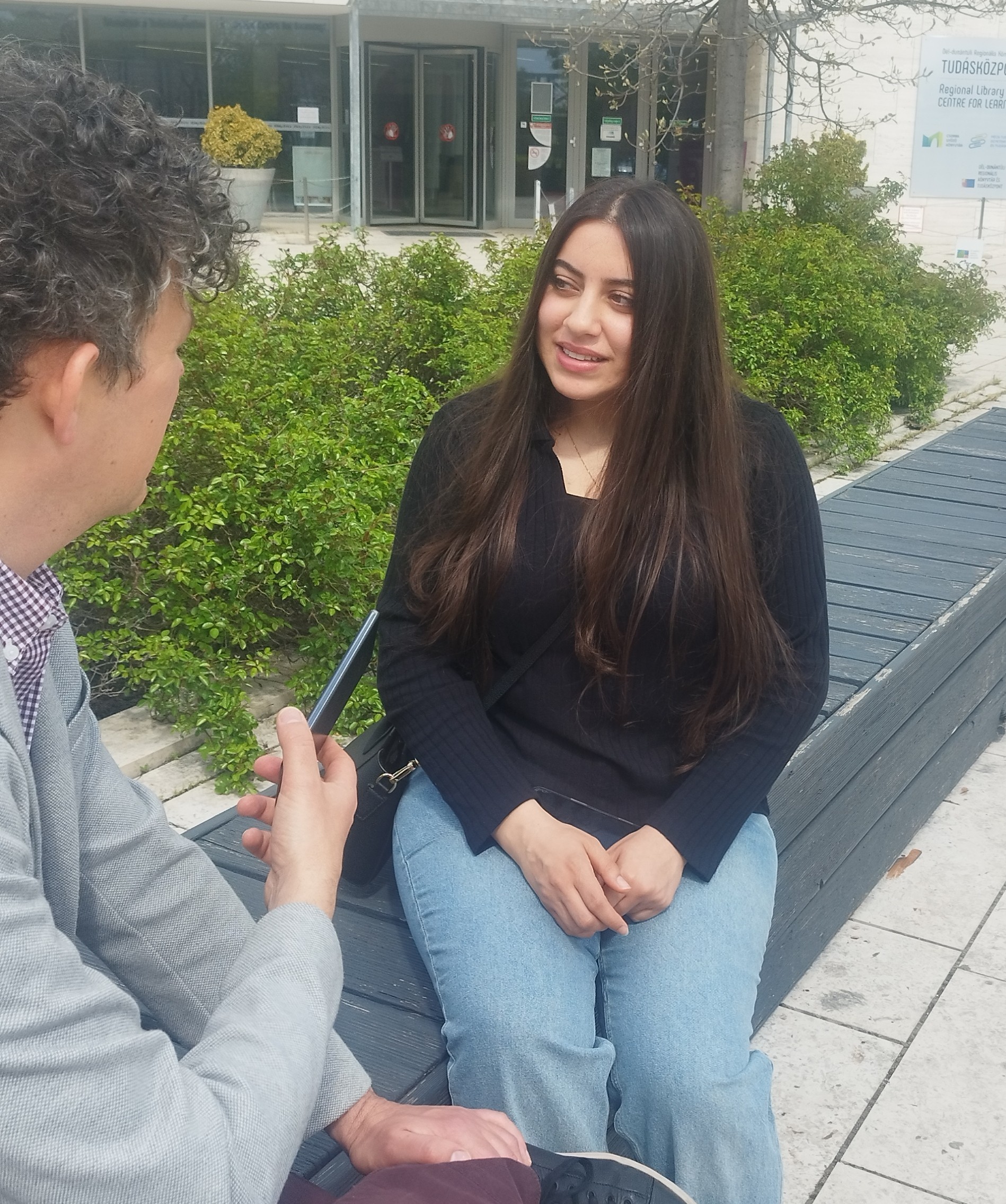
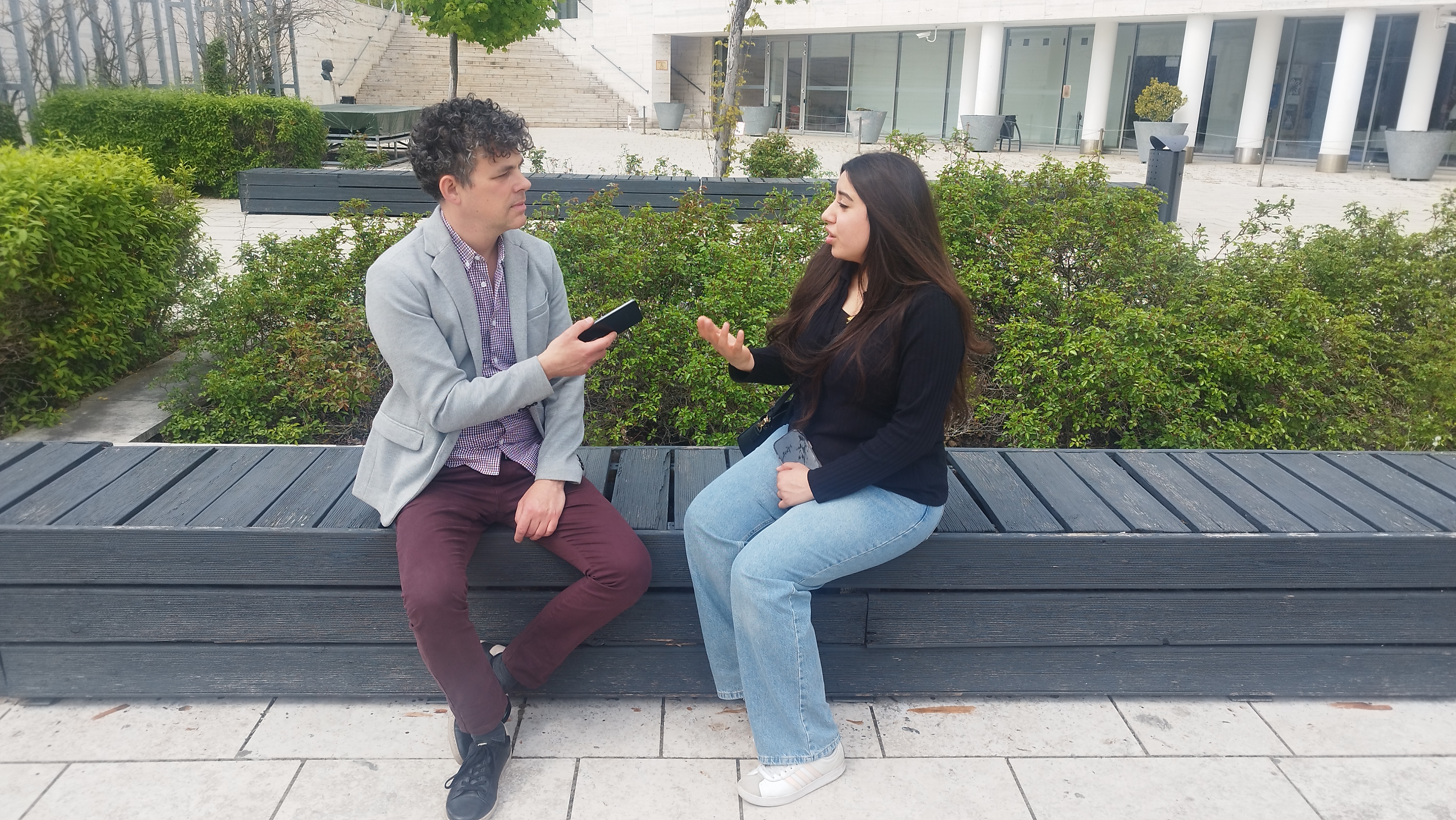
Volunteer for several global organisations, Dalia had already been supporting youth-led initiatives to foster cross-cultural exchange; provided on-site translation services between exhibitors and visitors, assisted with event operations at the Red Sea Half Marathon in her home country, Jordan. She has just completed her master's degree in International Relations at the University of Pécs. We caught her on the University Campus.
How did you end up on this professional path? What motivated you?
I already began to work in communications and international relations before starting my master's, which is very different from the bachelor, Applied English I earned in Jordan. I felt that studying international relations would be a better continuation of my professional path—simply more beneficial for my future. And I enjoy it.
Was it a difficult decision to leave your country and embark on such a big journey?
Not really, because I didn't come to Hungary directly from my home country. I had left Jordan years earlier, so I already had experience living and working abroad.
So, you arrived in Hungary in two steps.
Indeed. However, coming to Hungary specifically was challenging.
Why?
It was such a different culture, a different language, and a completely new place for me. That's where the challenge came from. I had some issues at the beginning, but then I got used to it. Now, it feels weird to leave Pécs.
Which country do you currently consider home?
Right now, home is where my mother and siblings are, which is Istanbul. So, when I go home, that's where I go to see them.
How often do you visit?
Whenever I have a long break, let’s say three or four times a year. The last time I was there was during the winter break, when I stayed for a month. It's been almost two years since you arrived in Pécs. How have you experienced everyday life as an international student? Pécs is far from being a huge metropolis like Istanbul.
I remember my first night here. The hotel I stayed at was farther from the city centre, so I didn't really get to see what the city looked like. I was just sitting outside thinking, "Oh my God, is this really a town?" I had seen pictures of Pécs online, but it's different in real life. It was already night, so I worried that it would be much smaller than I had imagined.
Did that impression change quickly?
Yes! Over the next few days, I explored most of the city centre, the faculties, which made things much easier. Pécs is very relaxing, and I've never lived in a place where, whenever I walk down the street, I run into familiar faces from the university and say, "Hi!". I really like that aspect. Pécs is such a perfect place for someone experiencing life abroad for the first time: it's manageable and full of international students, so you'll definitely find a group of people to connect with.
Did you experience any culture shock in Pécs?
It's sometimes way too quiet. When I'm walking with my friends, sometimes it feels like we're the only people talking loudly. We joke that we're the "loud Americans" of Pécs because, compared to us, Hungarians are super quiet. You don't often hear people talking loudly or shouting in the streets. I need more noise!
Was it easy to make friends here — quiet or outgoing, international or Hungarian?
For me, international students were easier to connect with. I have one Hungarian classmate who is one of my best friends here, and I've met two or three other Hungarians at events around the city. I'd say most of my friends here are international students.
You are an active member of Alumni Network Hungary and volunteer in the creation of promotional content. How did you decide to join us?
I heard about it through friends. They told me it was eye-opening and beneficial, especially after graduation, because it helps you stay connected with Hungary and the Tempus Public Foundation. When you leave, you miss the place where you spent two or three years of your life. So, I felt like it was a good opportunity for me to just keep up with what's happening, to still have a connection with the country after I leave. That's what motivated me.
Besides the quietness of Pécs, was there anything else you found challenging during your stay in Hungary?
I really miss familiar food because my mom is the best cook on the planet, and I'm not exactly a great cook myself. So, I'm on my own in the kitchen.
What do you miss most? Specific ingredients or spices?
Honestly, all of our food, because it's completely different from Hungarian cuisine.
How do you survive?
I go home to eat. Just kidding.
First, whenever I go home, I prepare a list for my mom. Second, there are many Jordanian students here and we tend to cook together, which is nice. I still have some of the spices they brought, which is amazing.
You are earning a master’s degree in International Relations. What are your plans after graduation?
Work.
Where?
For me, it's either Turkey or another nearby country because my partner is currently working there. I'd also love to use what I've learned at international organisations. That's where I see myself investing my experience and time. Hopefully, it will be possible because I've just started applying for jobs.
You're passionate about strengthening international relations. Are there any specific areas you'd like to focus on, such as diplomatic ties between Jordan and Hungary?
It's a bit further away from what you just mentioned, since I wrote my thesis on illegal settlements in the West Bank. As I am originally Palestinian, I would really love to work in a related field.
As for Jordan, I can imagine working to strengthen its relationships with other countries—whether that's between Jordan and Hungary or Jordan and somewhere else. We'll see what the future holds.
How do you feel about returning home?
I have really mixed emotions because Pécs feels like home now. I'm going to miss it so much! My friends and I have even started walking to university every morning because we keep saying we'll miss it next year. It's a lot of mixed feelings. I will miss Pécs, but at the same time, I'm excited to start my future and build on what I have learned.
How do you plan to maintain your connection with Hungary after you leave?
I will stay connected to Hungary by visiting whenever I miss the country and the people I met here. I know I will return to Hungary because I have close friends here.
I hope to remain involved with my alumni network, stay connected with the community and maintain the relationships I have developed. My experiences in Hungary have left a lasting impression on me, and I hope those connections will continue long after my studies are over.
Photo credit: Zsuzsanna Farkas