Should I work out today or go out with my friends? Should I focus on my career or go backpacking for a year? Modern life offers more opportunities than ever, but with so many choices comes a new challenge: countless decisions. While people have always had to make choices, they have rarely had such a wide range of paths and possibilities as they do now. Need help navigating the noise, decision fatigue, and the fear of missing out? Then read on!
Nowadays, we can be easily overwhelmed by the number of choices available to us.
Just take 4-storey malls with hundreds of shops as an example.
Or the endless amount of shows you scroll through on Netflix while trying to find the perfect watch.
But it’s not only consumerism that stacks decision upon decision. It’s also the crazy amount of information and content we receive about the world and about each other.

Think about social media and the thousands of posts you see daily: one became a fitness influencer, another decided to learn finance and „crack the code”, one moved to a farm, someone else became a TikTok celebrity…You probably have already found yourself thinking:
That sounds like a much cooler idea than what I am doing now….Should I just do that too?
But then the next day, another life path comes to your feed, and you already change your mind about what you got interested in yesterday.
This experience is especially common among graduates and young professionals.
In fact, it might seem like that the fear of choosing the „right path” is the most overwhelming at the beginning of your professional journey. The pressure is on simply because you are young. People tell you that this is the time to try everything, make core memories and experience it all, but at the same time build something bigger, something lasting, and find stability.
We are making decisions constantly, because it is inevitable. From choosing between junk food and a healthy meal to deciding whether to pursue a master's degree.
But processing the loss of the other possibility afterward – and nowadays we usually talk about thousands of other possibilities – is hard. Having more choices may seem like freedom, but actually it can put much more pressure on us. Even to the point that we are unable to decide anymore.
The Prime Era of Decision Fatigue
Decision fatigue has emerged as an important concept in psychology and behavioural decision-making. Psychologists define the term as the mental exhaustion caused by having to make numerous decisions. Constant evaluation is serious brainwork that can lead to cognitive overload. This doesn’t only make us feel tired and irritated, but ironically it also affects the quality of our decision-making in a negative way. Our judgement worsens, we become less sharp, and things can easily get out of control.

Normally, our brain will try to find smart and easy ways to avoid overthinking and save energy. However, these tricks do not always serve us. When overloaded, we are more likely to avoid decisions altogether, stick with familiar choices, or impulsively pick whatever feels best in the moment. It's basically our mind saying: "I can't deal with another pros and cons list right now." While these shortcuts can save energy in the short term, they can also lead to choices we later regret (Vohs et al., 2008; Baumeister et al., 1998).
Common Thought Patterns That Guide Our Decisions
Let’s look at some common thought patterns fueled by decision fatigue that may seem like a quick fix, but can lead to worse decisions:
"This choice seems easier/faster/safer/more comfortable..."
Seeking comfort and efficiency is a natural human reaction. There is nothing wrong with choosing the easier option when it genuinely feels right and supports your goals. For example, you obviously don’t want to overtrain the day before your marathon, because you will be exhausted.
However, growth rarely happens inside our comfort zones.
Things such as fear, laziness, pessimism, or negative self-talk often make us turn our backs on possibilities that could make us more successful.
The same applies to impulsivity. In the age of advanced technology and consumer culture, it is easy to develop an addiction to short-term satisfaction. When decision fatigue kicks in, our brain is yearning for immediate rewards and quick dopamine hits. As a result, we may sacrifice choices that support our long-term goals for ones that provide immediate comfort or enjoyment. For example, choosing junk food over a healthy meal may feel good in the moment, but the consequences for your body can be harmful in the long run. It's not necessarily a lack of discipline. Sometimes, it's simply a sign of mental exhaustion and the brain trying to protect itself. (Vohs et al., 2008; Baumeister et al., 1998; Mischel et al., 1989).
„This is too scary, I will just choose the other way”
Fear and anxiety can warn us about actual risks, but often they are just a sign that we are encountering something unfamiliar. We consider what's comfortable and predictable as the safer option, even when a new opportunity could be better. (Kahneman & Tversky, 1979; Samuelson & Zeckhauser, 1988). That’s how an easier choice today may cost you opportunities tomorrow.
So before deciding, ask yourself:
Am I just avoiding difficulty and possible growth because I am scared of it, or am I making a strategic decision?
There is an important difference.
"Others choose this, so I might as well do so."
Following the crowd can feel safe. If many people are choosing a particular product, career, or life path, it can seem like it’s the best choice. But just because something is popular, it doesn’t automatically mean that it will suit you too.
Something that might work perfectly for someone else may not align with your strengths, values, or long-term goals. Your decisions should support your own aspirations, so don’t let others choose instead of you.
Of course, if a product has good reviews, it can work as proof. But when it comes to your decisions about your career, lifestyle, or even how to spend your evening, doing the same as the majority is not the best decision you could make. It will only give you a weaker sense of who you are and what you strive to achieve.
„This is too scary, I will just choose the other way”
Fear and anxiety can warn us about actual risks, but often they are just a sign that we are encountering something unfamiliar. The easier choice today may cost you opportunities tomorrow.
So before choosing, ask yourself:
Am I just avoiding difficulty and possible growth because I fear it, or am I making a strategic decision?
There is an important difference.
"Maybe I can just not decide."
Sometimes - often in the case of overload - we might want to skip the decision-making completely.
But the truth is, no decision is also a decision. And possibly the worst one.
We can wait for the right answers, more guidance and more information, hoping it will give us more clarity, but chasing certainty too hard can leave us stuck, turning a simple decision into a source of stress and anxiety (Schwartz, 2004; Iyengar & Lepper, 2000).
Over time, opportunities pass, circumstances change, and we might just notice ourselves watching possibilities drift by.
Deciding, even if not perfectly, will always create more clarity than not taking any steps.
However it turns out, you will get to know more about yourself and the situation. Wrong choice? It’s not a failure. It’s a useful lesson you would have never had if you hadn’t dared to decide.
But how do we avoid falling into mental traps and experiencing decision fatigue?
While it’s impossible to always avoid the patterns completely, there are some ways you can prevent yourself from spiralling and ending up in the same traps.
For example:
- Develop routines and habits to reduce your daily load of decisions. If you have a fixed schedule or way of doing things, your brain has fewer puzzles to solve. (Baumeister et al., 1998).
- Set a deadline to prevent endless overthinking (Schwartz, 2004)
- Accept that "good enough" is often better than chasing a perfect answer (Simon, 1956; Schwartz, 2004).
- Prioritize important decisions earlier in the day (Vohs et al., 2008).
- Take breaks, eat, and sleep enough before major decisions, as self-control and decision quality decline when our basic necessities are not met (Vohs et al., 2008; Baumeister et al., 1998).
What If I Made the Wrong Decision?
Sometimes we fear making bad decisions, but few of the choices that we make are completely irreversible. Also, despite how good or bad we evaluate our choices, every decision generates information that is useful to us. About us, about others, about the situations, places, and overall, the world. Therefore, decision-making is one of the most powerful learning tools.
Actually, it might be the case that „wrong decisions” do not even exist. There are just decisions, leading us to different ways and unlocking different knowledge.
So instead of thinking about "What if this goes wrong?”, consider "What will I be able to learn with this decision?”
The result does not define you. What matters is what you do with the knowledge you gain.
Ultimately, we have to accept that we only have one life and we cannot try everything.
We will not see how the other choice would have turned out, but we will see and live the one that we ended up going for. We shouldn’t look too much into the past and judge ourselves for making the wrong decision or contemplate what could have been. Rather, we should focus on how we can make the most out of the chosen path, how we can enjoy and experience it to the fullest, and how we can learn from it.
Step Up Your Game with Our Masterclasses
Self-development isn’t just a trend. It’s your edge.
If you missed our previous session about decision-making, don’t worry. We still have many useful topics in store this year! The Alumni Masterclasses are here to help your self-development journey with fresh topics designed to help you grow, not just feel inspired for a day. From career planning and networking to sharpening your communication skills, these sessions give you the tools to turn potential into progress.
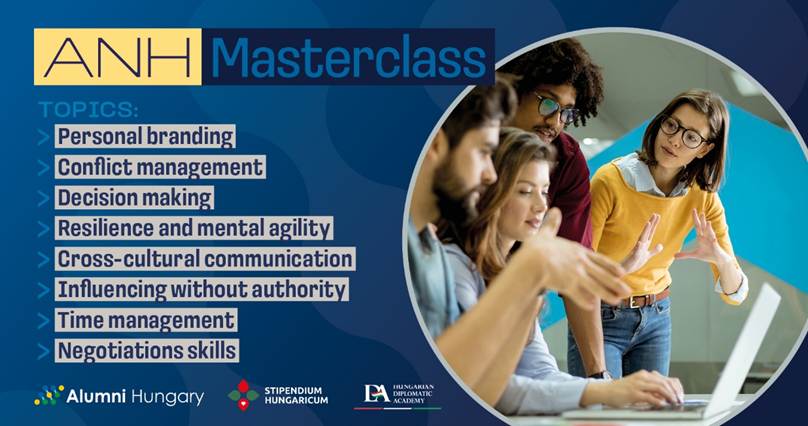
❗ Eligibility: Only SH scholarship holders who are registered members of the Alumni Network Hungary are eligible to apply.
📌 Stay tuned: Registration details and monthly topics will be shared in our newsletter on the Stipendium Hungaricum website and the Alumni Network Hungary platform.
Show up, level up, and invest in the thing that will always matter most: You. 💙
References
Vohs, K. D., Baumeister, R. F., Schmeichel, B. J., et al. (2008). Making choices impairs subsequent self-control: A limited-resource account of decision making, self-regulation, and active initiative. Journal of Personality and Social Psychology, 94(5), 883-898.
Baumeister, R. F., Bratslavsky, E., Muraven, M., & Tice, D. M. (1998). Ego depletion: Is the active self a limited resource? Journal of Personality and Social Psychology.
Mischel, W., Shoda, Y., & Rodriguez, M. I. (1989). Delay of gratification in children. Science, 244(4907), 933-938.
Kahneman, D., & Tversky, A. (1979). Prospect Theory: An Analysis of Decision under Risk. Econometrica, 47(2), 263-291.
Samuelson, W., & Zeckhauser, R. (1988). Status quo bias in decision making. Journal of Risk and Uncertainty, 1(1), 7-59.
Iyengar, S. S., & Lepper, M. R. (2000). When choice is demotivating: Can one desire too much of a good thing? Journal of Personality and Social Psychology, 79(6), 995-1006.